
Yoga for stress reduction is defined as the structured use of physical postures, controlled breathing, and mindfulness practices to activate the body’s relaxation response and lower physiological stress. A February 2026 meta-analysis of 30 studies with 2,288 participants found yoga produces a moderate effect size of -0.54 for stress relief. That number means yoga consistently moves the needle, not just for a lucky few. The practice works by shifting your nervous system out of fight-or-flight and into rest-and-recover mode, making it one of the most accessible stress management tools available today.
1. Yoga for stress reduction: which styles work best?
Not all yoga styles deliver the same stress relief. Three styles stand out based on clinical evidence and how they engage the nervous system.
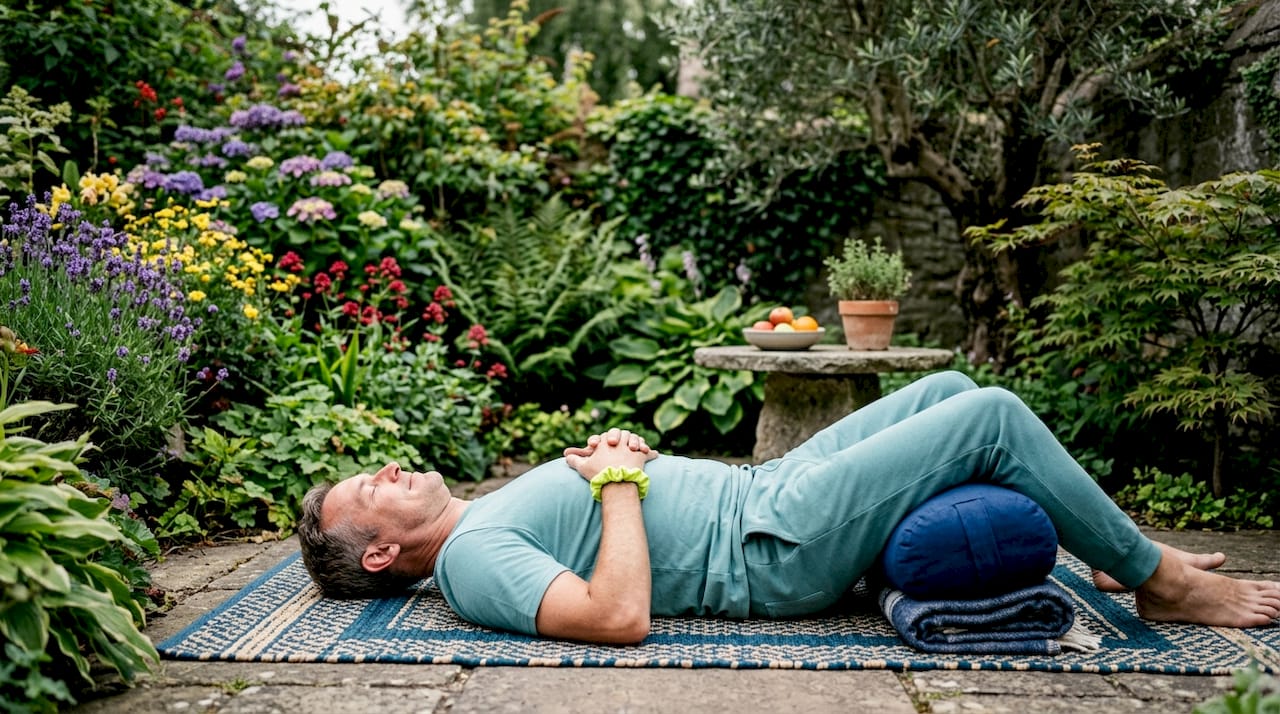
- Restorative yoga uses props like blankets and bolsters to support the body completely. You hold poses for 10–15 minutes, which gives the parasympathetic nervous system time to activate. This style is the most direct path to deep physical and mental relaxation.
- Hatha yoga combines gentle physical postures with breath awareness. Sessions move slowly, making it ideal for people who carry tension in their muscles and need a physical release alongside mental calm.
- Mindfulness yoga and Kundalini integrate breathwork, meditation, and movement. These styles address stress at the cognitive level, training your mind to disengage from anxious thought loops.
A June 2026 network meta-analysis comparing eight exercise modalities ranked yoga first for improving both depressive and anxiety symptoms. That result places yoga above high-intensity interval training, Pilates, and moderate-intensity cardio for mental health outcomes.
Pro Tip: If you are completely new to yoga, start with a single restorative pose held for five minutes rather than attempting a full sequence. The nervous system benefits kick in even in short sessions when you fully let go mentally.
2. Best yoga poses for stress and relaxation
The most effective yoga poses for stress reduction share one quality: they encourage the body to release effort rather than build it. Each pose below targets a specific physical pattern of tension that stress creates.
- Child’s Pose (Balasana): Kneel, sit back on your heels, and fold forward with arms extended or resting alongside your body. This pose decompresses the lower back and signals safety to the nervous system. Hold for 2–5 minutes.
- Legs-Up-the-Wall (Viparita Karani): Lie on your back and rest your legs vertically against a wall. This gentle inversion slows the heart rate and reduces leg fatigue from prolonged sitting. Hold for 5–10 minutes.
- Corpse Pose (Savasana): Lie flat on your back with arms slightly away from your sides. This is the most underrated pose in any practice. It gives your nervous system time to integrate everything that came before it. Hold for 5–15 minutes.
- Cat-Cow Stretch (Marjaryasana-Bitilasana): Move between arching and rounding your spine in sync with your breath. This rhythmic movement releases spinal tension and anchors attention to the breath, which interrupts stress-driven thinking.
- Supported Bridge Pose (Setu Bandha Sarvangasana): Place a folded blanket or firm pillow under your sacrum and let your hips rest on the support. This supported version opens the chest without muscular effort, making it far more relaxing than the active version.
Restorative yoga sessions held 10–15 minutes per pose maximize relaxation benefits. That duration gives the connective tissue and nervous system enough time to genuinely soften.
Pro Tip: You do not need a yoga mat or special equipment to start. A folded blanket works as a bolster, a wall replaces a strap, and a firm pillow substitutes for a block. Household items work well as effective prop substitutes for home practice.
3. How yoga physiologically reduces stress
Yoga changes your body chemistry in measurable ways. The table below summarizes the key mechanisms.
| Mechanism | What happens | Result |
|---|---|---|
| Parasympathetic activation | Slow breathing and gentle movement signal the vagus nerve | Heart rate drops, muscles relax |
| Cortisol reduction | HPA axis activity decreases with regular practice | Lower baseline stress hormone levels |
| GABA increase | Yoga raises gamma-aminobutyric acid in the brain | Reduced anxiety and improved mood |
| BDNF production | Brain-derived neurotrophic factor rises with consistent practice | Better emotional regulation over time |
Rhythmic breathing and slow movements directly lower physiological arousal by activating the parasympathetic nervous system. This is why yoga breathing exercises like diaphragmatic breathing and alternate nostril breathing produce calm within minutes. The physical postures reinforce this effect by releasing muscular tension that stress locks into the body.
Yoga’s effect on GABA is particularly significant. Low GABA levels are directly linked to anxiety disorders. Yoga raises GABA without medication, which explains why consistent practitioners report feeling less reactive to daily stressors over time.
4. How to build a home yoga practice for stress relief
A home practice removes every barrier between you and stress relief. You do not need a studio, a class schedule, or expensive gear.
- Set a consistent time. Morning practice prevents stress from accumulating. Evening practice clears the day’s tension before sleep. Pick one and protect it.
- Start with 15 minutes. A 15-minute session that includes one breathing exercise, two restorative poses, and Savasana delivers real benefits. Short sessions you actually do outperform long sessions you skip.
- Create a low-stimulation environment. Dim the lights, silence your phone, and use the same spot each time. Your nervous system learns to associate that space with relaxation.
- Set a mental intention. Before you begin, take three slow breaths and state a simple intention like “I am here to rest.” This shifts your brain out of task mode and into receptive mode.
- Avoid forcing poses. Stress-relieving yoga requires zero muscular effort in restorative positions. Holding poses without effort is the key to nervous system regulation. Pushing harder produces the opposite effect.
- Use a timer. Set a gentle alarm for each pose so you stop watching the clock. Mental surrender is what produces the benefit, and clock-watching prevents it.
Pro Tip: Even a five-minute restorative session yields measurable benefits when you fully switch off mentally. Quality of relaxation matters more than duration.
5. Choosing the right yoga approach for your situation
The right yoga practice depends on your age, stress level, experience, and any additional emotional health factors.
Older adults benefit most from gentle and restorative styles. Stress reduction benefits increase with age, with the effect size roughly doubling after age 30. This means a 50-year-old doing restorative yoga twice a week will likely see stronger results than a 20-year-old doing the same routine.
Beginners should start with supported poses and avoid any style that emphasizes physical challenge. Child’s Pose, Legs-Up-the-Wall, and Supported Bridge require no prior experience and deliver immediate nervous system benefits.
People with trauma or complex anxiety benefit from trauma-sensitive yoga, which removes performance expectations and gives practitioners full control over their movements. This approach is specifically designed to avoid re-triggering stress responses during practice.
People managing diagnosed anxiety disorders should treat yoga as a complement to professional care rather than a replacement. Yoga works best as an adjunct to therapy or medical treatment for clinical conditions. For everyday stress and general anxiety, yoga stands on its own.
Combining yoga with other stress reduction methods, such as guided meditation for stress, regular walking, or sleep hygiene practices, produces stronger results than any single approach alone.
6. What makes yoga more effective than other exercise for stress?
Yoga’s advantage over other forms of exercise comes from its simultaneous effect on the body and the mind. Running lowers cortisol. Yoga lowers cortisol and raises GABA while also training present-moment awareness. That combination is what makes it uniquely effective.
Yoga ranks first among eight exercise modalities for improving anxiety and depression symptoms. High-intensity training, by contrast, can temporarily spike cortisol before lowering it. For people already running on stress, that spike can feel counterproductive.
Yoga also has an exceptional safety record. A February 2026 umbrella review found no serious adverse events across its analyzed studies. That safety profile makes yoga accessible to people who cannot tolerate high-impact exercise due to injury, chronic illness, or age-related limitations.
Consistency and a tailored practice are the two factors that determine long-term stress relief outcomes. Frequency, session length, and matching the style to your specific needs all moderate how much benefit you receive.
7. Yoga breathing exercises that calm the nervous system fast
Yoga breathing exercises, known formally as pranayama, are the fastest-acting tools in the practice. They work because breath is the one autonomic function you can consciously control, giving you direct access to your stress response.
Diaphragmatic breathing involves breathing deeply into the belly rather than the chest. Place one hand on your stomach and breathe until it rises. This single technique activates the parasympathetic nervous system within 60 seconds.
4-7-8 breathing follows a pattern of inhaling for four counts, holding for seven, and exhaling for eight. The extended exhale is what triggers relaxation. A longer exhale than inhale signals the vagus nerve to slow the heart rate.
Alternate nostril breathing (Nadi Shodhana) involves closing one nostril at a time while breathing through the other in a set pattern. Research links this technique to reduced blood pressure and improved emotional balance. It is a core tool in Kundalini and mindfulness yoga for stress.
These techniques work as standalone practices between yoga sessions. Two minutes of diaphragmatic breathing before a stressful meeting, for example, produces measurable physiological calm.
8. Mindfulness yoga for stress: integrating awareness into movement
Mindfulness yoga for stress combines the physical benefits of postures with the cognitive benefits of present-moment awareness. The distinction from standard yoga is intentional: every movement is paired with deliberate attention to sensation, breath, and mental state.
The practice trains you to notice stress signals earlier. Most people recognize they are stressed only after tension has built for hours. Mindfulness yoga teaches you to catch the first signs, a tight jaw, shallow breathing, or a racing mind, before they escalate.
Body scan meditation is a core tool in this approach. You move attention systematically from your feet to your head, noticing areas of tension without trying to fix them. This practice alone reduces perceived stress significantly when done for 10 minutes daily.
Pairing body scan work with restorative poses creates a feedback loop. The pose releases physical tension, and the mindfulness practice releases the mental grip that caused it. Together, they address stress at both the body and mind level simultaneously.
9. Beginner yoga for stress relief: a simple starting sequence
A beginner sequence for stress relief does not need to be long or complex. The goal is to give your nervous system a clear signal that it is safe to relax.
Start with three minutes of diaphragmatic breathing in a comfortable seated or lying position. Follow with Cat-Cow for two minutes, moving slowly and syncing each movement with your breath. Move into Child’s Pose for five minutes, using a pillow under your forehead if needed. Transition to Legs-Up-the-Wall for five minutes. Finish with Savasana for five minutes.
That sequence takes 20 minutes and covers breathing, gentle movement, and deep rest. It addresses every physiological pathway through which yoga reduces stress. Repeat it three times per week for the first month, then adjust based on what your body needs.
The most common beginner mistake is rushing through poses to “get them done.” Stress-releasing yoga requires the opposite mindset. Slow down more than feels natural. The discomfort of stillness is exactly what you are training yourself to tolerate.
Key Takeaways
Yoga reduces stress most effectively when you match the style and poses to your specific needs, practice consistently, and prioritize mental surrender over physical effort.
| Point | Details |
|---|---|
| Yoga outperforms other exercise for stress | A 2026 network meta-analysis ranked yoga first among eight exercise modalities for anxiety and depression relief. |
| Restorative yoga delivers the deepest calm | Holding supported poses for 10–15 minutes activates the parasympathetic nervous system more effectively than active styles. |
| Age increases effectiveness | Stress reduction benefits roughly double after age 30, making yoga especially valuable for adults managing chronic stress. |
| Breathing exercises work immediately | Diaphragmatic breathing and 4-7-8 breathing activate the relaxation response within minutes, even outside a full yoga session. |
| Consistency matters more than duration | Short, regular sessions produce stronger long-term results than occasional long practices. |
Why I think most people approach stress-relief yoga the wrong way
Most people who try yoga for stress relief quit within a month. I have seen it repeatedly. They start with a 60-minute power flow class because it looks impressive, feel worse afterward, and conclude that yoga “isn’t for them.”
The research is clear on this. Restorative and gentle styles outperform vigorous ones for stress relief. But the fitness culture around yoga pushes challenge and intensity, which is the opposite of what a stressed nervous system needs.
My honest observation is this: the hardest part of stress-relieving yoga is doing less than you think you should. Lying in Supported Bridge for 12 minutes feels unproductive. Your brain tells you to move, to accomplish something. That resistance is the stress response itself. Staying in the pose anyway is the practice.
I also think people underestimate how much environment matters. The same pose done in a cluttered, bright room with notifications pinging produces half the benefit of the same pose done in a quiet, dim space. Set up your environment before you worry about perfecting your technique.
Be patient with yourself. The nervous system changes slowly. Give it four weeks of consistent practice before you judge the results.
— Ricky
Getvitalhome’s online yoga and wellness programs for stress relief
Getvitalhome offers online personal training programs that include yoga-focused sessions designed specifically for stress relief and mental well-being. Every plan is personalized to your experience level, schedule, and goals, so you are never following a generic routine that does not fit your life.
Whether you are a complete beginner or someone looking to deepen an existing practice, Getvitalhome’s virtual fitness classes give you access to guided sessions from home, on your schedule. You get the structure of professional coaching without the commute or the commitment of a studio membership. Visit Getvitalhome to see the full range of wellness programs built around your real-life needs.
FAQ
How often should I practice yoga to reduce stress?
Three sessions per week is the minimum for consistent stress relief benefits. Daily short sessions of 15–20 minutes produce stronger results than one long weekly class.
Can yoga replace therapy or medication for anxiety?
Yoga works best as a complement to professional care for diagnosed anxiety disorders, not as a replacement. For everyday stress and mild anxiety, yoga is effective as a standalone practice.
What is the fastest yoga technique for immediate stress relief?
Diaphragmatic breathing activates the parasympathetic nervous system within 60 seconds and requires no equipment or prior yoga experience.
Is yoga safe for people with physical limitations?
A 2026 umbrella review found no serious adverse events across yoga studies, confirming it is safe for most people. Restorative and chair-based styles accommodate injuries, chronic illness, and age-related limitations.
Does yoga work better for stress as you get older?
Yes. Research shows the stress-reducing effect of yoga roughly doubles after age 30, making it particularly effective for adults managing long-term or chronic stress.